
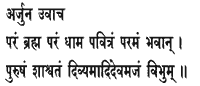
Arjuna said: Thou art the supreme Brahman, the supreme Abode, the supreme Purity, the one permanent, the divine Purusha, the original Godhead, the Unborn, the all-pervading Lord.
The Yoga of the Intelligent Will
Sri Aurobindo
I HAVE had to deviate in the last two essays and to drag the readerwith me into the arid tracts ofmetaphysical dogma,— however cursorily and with a very insufficient and superficial treatment,—so that we might understand why the Gita follows the peculiar line of development it has taken, working out first a partial truth with only subdued hints of its deeper meaning, then returning upon its hints and bringing out their significance until it rises to its last great suggestion, its supreme mystery which it does not work out at all, but leaves to be lived out, as the later ages of Indian spirituality tried to live it out in great waves of love, of surrender, of ecstasy. Its eye is always on its synthesis and all its strains are the gradual preparation of the mind for its high closing note. I have declared to you the poise of a self-liberating intelligence in Sankhya, says the divine Teacher to Arjuna. I will now declare to you another poise in Yoga. You are shrinking from the results of your works, you desire other results and turn from your right path in life because it does not lead you to them. But this idea of works and their result, desire of result as the motive, the work as a means for the satisfaction of desire, is the bondage of the ignorant who know not what works are, nor their true source, nor their real operation, nor their high utility. My Yoga will free you from all bondage of the soul to its works, karmabandham ˙ praha¯ syasi. You are afraid of many things, afraid of sin, afraid of suffering, afraid of hell and punishment, afraid of God, afraid of this world, afraid of the hereafter, afraid of yourself. What is it that you are not afraid of at this moment, you the Aryan fighter, the world’s chief hero? But this is the great fear which besieges humanity, its fear of sin and suffering now and hereafter, its fear in a world of whose true nature it is ignorant, of a God whose true being also it has not seen and whose cosmic purpose it does not understand. My Yoga will deliver you from the great fear and even a little of it will bring deliverance. When you have once set out on this path, you will find that no step is lost; every least movement will be a gain; you will find there no obstacle that can baulk you of your advance. A bold and absolute promise and one to which the fearful and hesitating mind beset and stumbling in all its paths cannot easily lend an assured trust; nor is the large and full truth of it apparent unless with these first words of the message of the Gita we read also the last, “Abandon all laws of conduct and take refuge in Me alone; I will deliver you from all sin and evil; do not grieve.” But it is not with this deep and moving word of God to man, but rather with the first necessary rays of light on the path, directed not like that to the soul, but to the intellect, that the exposition begins. Not the Friend and Lover of man speaks first, but the guide and teacher who has to remove from him his ignorance of his true self and of the nature of the world and of the springs of his own action. For it is because he acts ignorantly, with a wrong intelligence and therefore a wrong will in these matters, that man is or seems to be bound by his works; otherwise works are no bondage to the free soul. It is because of this wrong intelligence that he has hope and fear, wrath and grief and transient joy; otherwise works are possible with a perfect serenity and freedom. Therefore it is the Yoga of the buddhi, the intelligence, that is first enjoined on Arjuna. To act with right intelligence and, therefore, a rightwill, fixed in the One, aware of the one self in all and acting out of its equal serenity, not running about in different directions under the thousand impulses of our superficial mental self, is the Yoga of the intelligent will. There are, says the Gita, two types of intelligence in the human being. The first is concentrated, poised, one, homogeneous, directed singly towards the Truth; unity is its characteristic, concentrated fixity is its very being. In the other there is no single will, no unified intelligence, but only an endless number of ideas many-branching, coursing about, that is to say, in this or that direction in pursuit of the desires which are offered to it by life and by the environment. Buddhi, the word used,means, properly speaking, the mental power of understanding but it is evidently used by the Gita in a large philosophic sense for the whole action of the discriminating and deciding mind which determines both the direction and use of our thoughts and the direction and use of our acts; thought, intelligence, judgment, perceptive choice and aim are all included in its functioning: for the characteristic of the unified intelligence is not only concentration of the mind that knows, but especially concentration of the mind that decides and persists in the decision, vyavas¯aya, while the sign of the dissipated intelligence is not so much even discursiveness of the ideas and perceptions as discursiveness of the aims and desires, therefore of the will. Will, then, and knowledge are the two functions of the Buddhi. The unified intelligent will is fixed in the enlightened soul, it is concentrated in inner self-knowledge; the many-branching and multifarious, busied with many things, careless of the one thing needful is on the contrary subject to the restless and discursive action of the mind, dispersed in outward life and works and their fruits. “Works are far inferior,” says the Teacher, “to Yoga of the intelligence; desire rather refuge in the intelligence; poor and wretched souls are they who make the fruit of their works the object of their thoughts and activities.” We must remember the psychological order of the Sankhya which the Gita accepts. On one side there is the Purusha, the soul calm, inactive, immutable, one, not evolutive; on the other side there is Prakriti or Nature-force inert without the conscious Soul, active but only by juxtaposition to that consciousness, by contact with it, as we would say, not so much one at first as indeterminate, triple in its qualities, capable of evolution and involution. The contact of soul and nature generates the play of subjectivity and objectivity which is our experience of being; what is to us the subjective first evolves, because the soulconsciousness is the first cause, inconscient Nature-force only the second and dependent cause; but still it is Nature and not Soul which supplies the instruments of our subjectivity. First in order come Buddhi, discriminative or determinative power evolving out of Nature-force, and its subordinate power of selfdiscriminating ego. Then as a secondary evolution there arises out of these the power which seizes the discriminations of objects, sense-mind or Manas,—we must record the Indian names because the corresponding English words are not real equivalents. As a tertiary evolution out of sense-mind we have the specialising organic senses, ten in number, five of perception, five of action; next the powers of each sense of perception, sound, form, scent, etc., which give their value to objects for the mind and make things what they are to our subjectivity,— and, as the substantial basis of these, the primary conditions of the objects of sense, the five elements of ancient philosophy or rather elementary conditions of Nature, pan˜ ca bhu¯ ta, which constitute objects by their various combination. Reflected in the pure consciousness of Purusha these degrees and powers of Nature-force become the material of our impure subjectivity, impure because its action is dependent on the perceptions of the objective world and on their subjective reactions. Buddhi, which is simply the determinative power that determines all inertly out of indeterminate inconscient Force, takes for us the form of intelligence and will. Manas, the inconscient force which seizes Nature’s discriminations by objective action and reaction and grasps at them by attraction, becomes sense-perception and desire, the two crude terms or degradations of intelligence and will,—becomes the sense-mind sensational, emotive, volitional in the lower sense of wish, hope, longing, passion, vital impulsion, all the deformations (vik¯ara) of will. The senses become the instruments of sense-mind, the perceptive five of our senseknowledge, the active five of our impulsions and vital habits, mediators between the subjective and objective; the rest are the objects of our consciousness, vis.ayas of the senses. This order of evolution seems contrary to that which we perceive as the order of the material evolution; but if we remember that even Buddhi is in itself an inert action of inconscient Nature and that there is certainly in this sense an inconscient will and intelligence, a discriminative and determinative force even in the atom, if we observe the crude inconscient stuff of sensation, emotion, memory, impulsion in the plant and in the subconscient forms of existence, if we look at these powers of Nature-force assuming the forms of our subjectivity in the evolving consciousness of animal and man, we shall see that the Sankhya system squares well enough with all that modern enquiry has elicited by its observation of material Nature. In the evolution of the soul back from Prakriti towards Purusha, the reverse order has to be taken to the original Nature-evolution, and that is how the Upanishads and the Gita following and almost quoting the Upanishads state the ascending order of our subjective powers. “Supreme, they say,” beyond their objects “are the senses, supreme over the senses the mind, supreme over the mind the intelligent will: that which is supreme over the intelligent will, is he,”—is the conscious self, the Purusha. Therefore, says the Gita, it is this Purusha, this supreme cause of our subjective life which we have to understand and become aware of by the intelligence; in that we have to fix our will. So holding our lower subjective self in Nature firmly poised and stilled by means of the greater really conscient self, we can destroy the restless ever-active enemy of our peace and self-mastery, the mind’s desire. For evidently there are two possibilities of the action of the intelligent will. It may take its downward and outward orientation towards a discursive action of the perceptions and the will in the triple play of Prakriti, or it may take its upward and inward orientation towards a settled peace and equality in the calm and immutable purity of the conscious silent soul no longer subject to the distractions of Nature. In the former alternative the subjective being is at the mercy of the objects of sense, it lives in the outward contact of things. That life is the life of desire. For the senses excited by their objects create a restless or often violent disturbance, a strong or even headlong outward movement towards the seizure of these objects and their enjoyment, and they carry away the sense-mind, “as the winds carry away a ship upon the sea”; the mind subjected to the emotions, passions, longings, impulsions awakened by this outward movement of the senses carries away similarly the intelligent will, which loses therefore its power of calm discrimination and mastery. Subjection of the soul to the confused play of the three gunas of Prakriti in their eternal entangled twining and wrestling, ignorance, a false, sensuous, objective life of the soul, enslavement to grief and wrath and attachment and passion, are the results of the downward trend of the buddhi,— the troubled life of the ordinary, unenlightened, undisciplined man. Those who like the Vedavadins make sense-enjoyment the object of action and its fulfilment the highest aim of the soul, are misleading guides. The inner subjective self-delight independent of objects is our true aim and the high and wide poise of our peace and liberation. Therefore, it is the upward and inward orientation of the intelligent will that we must resolutely choose with a settled concentration and perseverance, vyavas¯aya; wemust fix it firmly in the calm self-knowledge of the Purusha. The first movement must be obviously to get rid of desire which is the whole root of the evil and suffering; and in order to get rid of desire, we must put an end to the cause of desire, the rushing out of the senses to seize and enjoy their objects. We must draw them back when they are inclined thus to rush out, draw them away from their objects,—as the tortoise draws in his limbs into the shell, so these into their source, quiescent in the mind, the mind quiescent in intelligence, the intelligence quiescent in the soul and its selfknowledge, observing the action of Nature, but not subject to it, not desiring anything that the objective life can give. It is not an external asceticism, the physical renunciation of the objects of sense that I am teaching, suggests Krishna immediately to avoid a misunderstanding which is likely at once to arise. Not the renunciation of the Sankhyas or the austerities of the rigid ascetic with his fasts, his maceration of the body, his attempt to abstain even from food; that is not the selfdiscipline or the abstinence which I mean, for I speak of an inner withdrawal, a renunciation of desire. The embodied soul, having a body, has to support it normally by food for its normal physical action; by abstention from food it simply removes from itself the physical contact with the object of sense, but does not get rid of the inner relation which makes that contact hurtful. It retains the pleasure of the sense in the object, the rasa, the liking and disliking,—for rasa has two sides; the soul must, on the contrary, be capable of enduring the physical contact without suffering inwardly this sensuous reaction. Otherwise there is nivr.tti, cessation of the object, vis.ay¯a vinivartante, but no subjective cessation, no nivr.tti of the mind; but the senses are of the mind, subjective, and subjective cessation of the rasa is the only real sign of mastery. But how is this desireless contact with objects, this unsensuous use of the senses possible? It is possible, para ˙ m dr. s. t. v¯a, by the vision of the supreme,—param, the Soul, the Purusha,—and by living in the Yoga, in union or oneness of the whole subjective being with that, through the Yoga of the intelligence; for the one Soul is calm, satisfied in its own delight, and that delight free from duality can take, once we see this supreme thing in us and fix the mind and will on that, the place of the sensuous object-ridden pleasures and repulsions of the mind. This is the true way of liberation. Certainly self-discipline, self-control is never easy. All intelligent human beings know that they must exercise some control over themselves and nothing is more common than this advice to control the senses; but ordinarily it is only advised imperfectly and practised imperfectly in the most limited and insufficient fashion. Even, however, the sage, the man of clear, wise and discerning soul who really labours to acquire complete self-mastery finds himself hurried and carried away by the senses. That is because the mind naturally lends itself to the senses; it observes the objects of sense with an inner interest, settles upon them and makes them the object of absorbing thought for the intelligence and of strong interest for the will. By that attachment comes, by attachment desire, by desire distress, passion and anger when the desire is not satisfied or is thwarted or opposed, and by passion the soul is obscured, the intelligence and will forget to see and be seated in the calm observing soul; there is a fall from the memory of one’s true self, and by that lapse the intelligent will is also obscured, destroyed even. For, for the time being, it no longer exists to our memory of ourselves, it disappears in a cloud of passion; we become passion, wrath, grief and cease to be self and intelligence and will. This then must be prevented and all the senses brought utterly under control; for only by an absolute control of the senses can the wise and calm intelligence be firmly established in its proper seat. This cannot be done perfectly by the act of the intelligence itself, by a merely mental self-discipline; it can only be done by Yoga with something which is higher than itself and in which calm and self-mastery are inherent. And this Yoga can only arrive at its success by devoting, by consecrating, by giving up the whole self to the Divine, “toMe”, says Krishna; for the Liberator is within us, but it is not our mind, nor our intelligence, nor our personal will,—they are only instruments. It is the Lord in whom, as we are told in the end, we have utterly to take refuge. And for that we must at first make him the object of our whole being and keep in soul-contact with him. This is the sense of the phrase “he must sit firm in Yoga, wholly given up to Me”; but as yet it is the merest passing hint after the manner of the Gita, three words only which contain in seed the whole gist of the highest secret yet to be developed. Yukta ¯ as¯ıta matparah. . If this is done, then it becomes possible to move among the objects of sense, in contact with them, acting on them, but with the senses entirely under the control of the subjective self, —not at the mercy of the objects and their contacts and reactions,— and that self again obedient to the highest self, the Purusha. Then, free from reactions, the senses will be delivered from the affections of liking and disliking, escape the duality of positive and negative desire, and calm, peace, clearness, happy tranquillity, ¯atmapras¯ada, will settle upon the man. That clear tranquillity is the source of the soul’s felicity; all grief begins to lose its power of touching the tranquil soul; the intelligence is rapidly established in the peace of the self; suffering is destroyed. It is this calm, desireless, griefless fixity of the buddhi in selfpoise and self-knowledge to which the Gita gives the name of Samadhi. The sign of the man in Samadhi is not that he loses consciousness of objects and surroundings and of his mental and physical self and cannot be recalled to it even by burning or torture of the body,—the ordinary idea of the matter; trance is a particular intensity, not the essential sign. The test is the expulsion of all desires, their inability to get at the mind, and it is the inner state from which this freedom arises, the delight of the soul gathered within itselfwith themind equal and still and highpoised above the attractions and repulsions, the alternations of sunshine and storm and stress of the external life. It is drawn inward even when acting outwardly; it is concentrated in self even when gazing out upon things; it is directed wholly to the Divine even when to the outward vision of others busy and preoccupied with the affairs of the world. Arjuna, voicing the average human mind, asks for some outward, physical, practically discernible sign of this great Samadhi; how does such a man speak, how sit, how walk? No such signs can be given, nor does the Teacher attempt to supply them; for the only possible test of its possession is inward and that there are plenty of hostile psychological forces to apply. Equality is the great stamp of the liberated soul and of that equality even the most discernible signs are still subjective. “A man with mind untroubled by sorrows, who has done with desire for pleasures, from whom liking and wrath and fear have passed away, such is the sage whose understanding has become founded in stability.” He is “without the triple action of the qualities of Prakriti, without the dualities, ever based in his true being, without getting or having, possessed of his self.” For what gettings and havings has the free soul? Once we are possessed of the Self, we are in possession of all things. And yet he does not cease from work and action. There is the originality and power of the Gita, that having affirmed this static condition, this superiority to nature, this emptiness even of all that constitutes ordinarily the action of Nature for the liberated soul, it is still able to vindicate for it, to enjoin on it even the continuance of works and thus avoid the great defect of the merely quietistic and ascetic philosophies,—the defect from which we find them today attempting to escape. “Thou hast a right to action, but only to action, never to its fruits; let not the fruits of thy works be thy motive, neither let there be in thee any attachment to inactivity.” Therefore it is not the works practised with desire by the Vedavadins, it is not the claim for the satisfaction of the restless and energetic mind by a constant activity, the claim made by the practical or the kinetic man, which is here enjoined. “Fixed in Yoga do thy actions, having abandoned attachment, having become equal in failure and success; for it is equality that is meant by Yoga.” Action is distressed by the choice between a relative good and evil, the fear of sin and the difficult endeavour towards virtue? But the liberated who has united his reason and will with the Divine, casts away from him even here in this world of dualities both good doing and evil doing; for he rises to a higher law beyond good and evil, founded in the liberty of self-knowledge. Such desireless action can have no decisiveness, no effectiveness, no efficient motive, no large or vigorous creative power? Not so; action done in Yoga is not only the highest but the wisest, the most potent and efficient even for the affairs of the world; for it is informed by the knowledge and will of the Master of works: “Yoga is skill in works.” But all action directed towards life leads away from the universal aim of the Yogin which is by common consent to escape from bondage to this distressed and sorrowful human birth? Not so, either; the sages who do works without desire for fruits and in Yoga with the Divine are liberated from the bondage of birth and reach that other perfect status in which there are none of the maladies which afflict the mind and life of a suffering humanity. The status he reaches is the Brahmic condition; he gets to firm standing in the Brahman, br¯ahm¯ı sthiti. It is a reversal of the whole view, experience, knowledge, values, seeings of earthbound creatures. This life of the dualities which is to them their day, their waking, their consciousness, their bright condition of activity and knowledge, is to him a night, a troubled sleep and darkness of the soul; that higher being which is to them a night, a sleep in which all knowledge and will cease, is to the self-mastering sage his waking, his luminous day of true being, knowledge and power. They are troubled and muddy waters disturbed by every little inrush of desire; he is an ocean of wide being and consciousness which is ever being filled, yet ever motionless in its large poise of his soul; all the desires of the world enter into him as waters into the sea, yet he has no desire nor is troubled. For while they are filled with the troubling sense of ego and mine and thine, he is one with the one Self in all and has no “I” or “mine”. He acts as others, but he has abandoned all desires and their longings. He attains to the great peace and is not bewildered by the shows of things; he has extinguished his individual ego in the One, lives in that unity and, fixed in that status at his end, can attain to extinction in the Brahman, Nirvana,—not the negative self-annihilation of the Buddhists, but the great immergence of the separate personal self into the vast reality of the one infinite impersonal Existence. Such, subtly unifying Sankhya, Yoga and Vedanta, is the first foundation of the teaching of the Gita. It is far from being all, but it is the first indispensable practical unity of knowledge and works with a hint already of the third crowning intensest element in the soul’s completeness, divine love and devotion.
Sri Aurobindo
 About Us| ©1999 - 2009 searchforlight.org
All extracts and quotations from the written works of Sri Aurobindo and the Mother and the Photographs of
the Mother and Sri Aurobindo are copyright Sri Aurobindo Ashram Trust, Pondicherry -605002 India.